25 August 2013

Rielizations of wallet and of self

The currency situation here is somewhat unusual in that the country is 95% dollarized.  Most everything is quoted in dollars, not just the hotels and restaurants catering to tourists—everything from 600-acre plots of land to plates of curry are priced in USD.  The only things that really can’t be paid for in dollars are those that cost less than $1, in which case you’re looking at payment in riels.  To convolute things slightly further, the riel is still very much alive and in use in denominations up to 20,000 (the largest I’ve seen and the equivalent of $5), so it’s certainly possible to use it for amounts more than that; in the local marketplaces, some vendors even prefer seem to prefer riels.  Oh, and the cashpoints?  Most of them dispense USD, but the ANZ Bank ones will ask you which currency you’d like to withdraw.

It is entirely possible for tourists to spend their entire stay dealing in dollars, and I at least started out with a wallet full of American currency, which is definitely preferred for larger amounts like my 3-day pass to Angkor and horseback trek out to Wat Athvea.  Once I got into the heart of Siem Reap’s local marketplace, though, with its glistening sides of beef slapped on wooden tables down one side and rainbow of bagged spices down the other, it was riels all the way.  Same with the fruit vendors from whom I bought cut-up green mangos sprinkled with chili and lime, same with the kids using machetes to hack off the top of baby green coconuts and proffering straws, same with the little corner store where I bought a pack of tissues.  At the more local dining establishments, which tend to be my go-to, my change came half in dollars, half in riels, and at one point I became aware that my wallet had been substantially rielized.  By the time I got to Sihanoukville, I had enough to pay for my guesthouse completely in riels, though, to be fair, the bill came to 24,000, the equivalent of a whopping $6.

The evolution of my billfold has kind of mirrored the evolution of my entire trip, to be frank.  The place I stayed in Siem Reap was a luxury, a lush, calm, and quietly posh retreat, and having my own tuk-tuk driver for three days to show me around the ruins was a lovely convenience.  The private car to Phnom Penh, too, was a luxury, and my hotel in the city was also beautifully done and wouldn’t have looked out of place in Rome or Paris.

After Phnom Penh, though, there was a noticeable change, very much without my planning it that way.  The plan was to take a bus at 8am for the four-hour trip, which really isn’t that long, and I figured I would have more than enough of a time cushion to book my ticket at 1pm for a 2pm ferry out to the island of Koh Rong.  (I said I would do the long-distance bus thing again, didn’t I?)  The driver of said bus, unfortunately, seemed to have zero sense of urgency and was more concerned with taking frequent smoke breaks than getting us to Sihanoukville, so after leaving 20 minutes late we rolled into the station at 1.30.  I knew I was pushing it already, so when the first guy approached my backpack and me asking if I wanted to go somewhere, I said, “YES!  Koh Rong Dive Center, please.”  He pulled out a moto, which, given the weight and bulk of the pack, wouldn’t have been my first choice (a tuk-tuk seemed the more stable option), but whatever.  He hauled it up so it perched in front of him between the handlebars, swung aboard, and gave me a hand arranging myself on the back.  “Oh, and we need to go fast,” I told him.

Well, he took that to heart.  As we pelted down one of Sihanoukville’s many hills and whipped past cars and tuk-tuks, my inclination was that I would be much less likely to go flying off when we rounded the next corner if I grabbed the driver around the middle, like a chimpanzee, but I can only imagine how that would look to Cambodian onlookers and wasn’t particularly keen on embracing a stranger anyway.  Instead I gripped the side of the seat with one hand and steadied my handbag with the other, ensuring that at least my laptop wouldn’t make a flying exit (I did not fancy having to explain that to the company’s IT department).   I thought briefly of my smooth ride in the back of the car down to Phnom Penh, which, from the back of the mud-spattered moto, seemed a lifetime ago.

We skidded to a halt at the dive center at 1.45, where I relayed the story of my incompetent bus driver and made an impassioned plea to get on the 2pm boat to no avail.  “Do you know another place that runs ferries out, maybe later?” I asked my speed demon moto driver, who nodded, and we were back on the road.  After a loop of the Gold Lion traffic circle and a quick left turn, we were at another little travel shop, which, unfortunately, had also sent out its last ferry for the day.

An extremely tan and bony American woman came out to explain, “The waves are really high at this hour.  Like mountains.”  She widened her eyes and made mountain shapes with her hands as she said this.  She may or may not have been high.  “So the thing to do would be get the 8 o’ clock boat tomorrow morning.”  She gestured around at the basic but functional guesthouse behind her and shrugged.  “Just stay here for the night.  Do you want a beer?”

And I did stay, paying less than what I would for a trip on BART for a room of my own and cold running water.

(I declined the beer, though, in favor of a few pina coladas down on Otres Beach later that afternoon.  Another story for another time.)

From there, I’ve gone straight back down the dirty backpacker path.  I hopped an early ferry to Koh Rong, which makes the experience sound much quicker and easier than it actually was, as we were sailing straight into a morning storm (ah, rainy season rears its head).  The boat itself was functional and admittedly more comfortable than it looked, with its hard wooden benches on the bottom deck and its paint peeling off.  The top bit had plastic curtains that we were able to roll down to shield against the rain along with a mess of faded cushions on the floor, so I spent the ride supine, listening to music and rather enjoying the four-foot swells.  Luxurious, however, it was not.

Here on Koh Rong, I’m staying in a bungalow up in the trees, overlooking the village of Koh Tach and the wide crescent of white sand, just me, a mosquito net, a bucket shower, and electricity until 10pm (the entire island runs off a generator, which should give you some idea of how few people there are here).  If I look down I can see the jungle floor through the gaps in my floorboards and when I listen very carefully I can hear the footsteps of the geckos in the nooks of the palapa roof.  It is nothing more or less than I really need out here on this most storybook of islands.

Who needs maid service in a place like this?
In this way, I guess, I haven’t really changed that much since I was eighteen.  I’ve got my same backpack, which has made quite the tour with me at this point, same flip flops, same bikini even, and along with all that, my same fondness for unidentifiable street food and the rustic sort of lull that comes with traveling the developing world.  Sitting in the car from Siem Reap, I think that a small part of me was worried that I was getting too old to ever experience this, or rather, actually enjoy experiencing this, again.  But I’ve found myself here in my very unattractive but comfortable Indonesian fisherman pants, wandering the village barefoot without a stitch of makeup, hair tied up in an unkempt chignon and reasoning that a dip in the ocean is just as good as a shower.  Sure enough, I’ve accumulated the wristwear that seems to inevitably find its way onto your body when you backpack, in this case a lime-green woven bracelet from one of the incense women at Angkor (“long life,” remember) and a brown-checkered ropey thing that a little girl gave me when I bought a coconut from her family’s stand.

And so, as the dollars in my wallet have turned to riels, I’ve turned from a clean and somewhat respectable-looking traveler to the sort of bronzed but kind of grimy-looking douchebag backpacker that people don’t like standing next to in the airport.

Compared to a lot of the Westerners here, though, I’m not actually that grimy (I feel that this is important to point out), and I’ll confess that I booked the nicest resort in Sihanoukville for my last night in Cambodia (the five-star experiences comes pretty cheap here).  A hot shower, a massage, and a cup of coffee and I’ll look much less feral for my flight to Seoul.

Still, it’s nice to know that in this way, at least, I’m far from being “too old,” which is something that a lot of us twentysomethings seem to fear, probably irrationally.  I may not be able to throw back shots and stay out as late as I once did, and yes, I actually enjoy things like furniture shopping and Burgundian wine now, but I’ve got a few more years of chicken buses and bucket showers left yet.  Here’s to being a dirty backpacker.

For your viewing pleasure, see below for some photos of the dirty backpacking days of yore.
In Tunisia, instead of taking the bus from Douz to Djerba, we splurged and hired this guy and his car.

c
The buds on a long-distance coach ride up the west coast of Ireland.  This was the trip where at one point we got so cold and hungry that the three of us devoured a roast chicken on a bench in about two minutes.

Harem pants?  Check.  Dirty cloth bag?  Check.  Clearly unwashed hair?  Check.  Enthusiastic but not entirely appropriate adoption of local culture?  Check.  (In my defense, the bindi was a gift.)     
   

23 August 2013

Getting your kicks on National Route 6 (just avoid the livestock)

When it came time to make the trek across the country from Siem Reap to Phnom Penh, I had two options.  I could either get a tuk-tuk to the main bus station and sit through a cramped six hours of wailing infants and Khmer soap operas played on the little main screen at shattering volumes, or I could hire a driver.

This sounds decadent, I know, but I just found the idea of getting in a nicely maintained car, zipping down to the capital in a mere four hours, being able to stop and buy fruit or water at my leisure, and then getting deposited at my hotel in Phnom Penh a lot more appealing.  I’ve done the long-distance bus thing before, believe me, and I’ll do it again, just not this time. 

I offer you one such example: at age seventeen I found myself squeezed three people to a two-person seat on a glorified school bus run by a Tanzanian bus company with a record for killing at least two people a year, windows rolled down to get some kind of a breeze in there and red dust pouring in as a result.  The driver, when he stepped on board, looked to be about my age, with the added bonus of having extremely red eyes, and he went on to keep his hand to the horn for most of the next eight hours over what I can assure you is not the best-paved road on earth.  The bathroom on our first stop was a trough in a concrete box with no windows, the smell so exquisitely awful that to this day I can remember it in perfect detail, and the bathroom on our second stop was literally a ditch on the side of the road where Elizabeth, the mother of my host family, held up a kanga to shield me from the eyes of Tanzanians who were apparently curious to see what a white girl squatting in the dirt looked like.  I also spent most of the ride staring back at a tiny girl of about three who would not take her eyes off me, or off my pale skin and ridiculous-looking hair, while behind me, another slightly older child would reach out tentatively to brush the ends of my ponytail, no doubt imagining that he was being subtle.  There were animals strapped to the roof and hawkers shoving groundnuts and oranges at us through the windows every time we came to a stop and utter bedlam when we finally pulled into the station in Kariakoo, a neighborhood in Dar that is, shall we say, definitely not on the tourist radar.

So, yes, I am quite familiar with long-distance developing world bus travel, thanks.
Young, tough 'n dirty backpacking days.  Long-distance buses were definitely ridden.
But, given that I’m an adult and I’m on vacation and I wanted those two extra hours in Phnom Penh, I opted for the car.

It was definitely quieter and more comfortable than the bus; however, it become obvious very fast that my chauffeur was driving as if his pay were directly linked to how quickly he got me to the capital.  Our first very brief stop was just outside Siem Reap to fill up the car and buy water, where he bought three cans of the Cambodian equivalent of Red Bull, finishing the first in one fast, violent chug before stepping back behind the wheel.  I’m not sure if it was this or some other substance that had him twitching his head, sniffling, and blinking rapidly, but the guy was turned up.  Nice, of course, courteous, and very turned up.  For a while I watched through the windshield, admiring and fascinated by his lighting-quick reflexes and weaving manoeuvers, as we ducked in and out of our lane, skirting massive shipping trucks, fellow sedans, tuk-tuks, motos, bicycles, pedestrians, and herds of cows with every flick of the turn signal, and then settled into the backseat, assured that he knew what he was doing.

The thing about National Route 6 is that, while it may be the most important route in the country, running between Phnom Penh and Siem Reap and then on to the Thai border, it’s a stretch to even call it a two-lane road.  There is a ribbon of asphalt wide enough for two mid-sized cars, maybe two Range Rovers at a stretch, to drive next to each other, wide shoulders of red dirt, and nothing in the way of a dividing line down the middle.  There are also a lot of other things on National Route 6 apart from cars, i.e. the aforementioned tuk-tuks, motos, bicycles, pedestrians, and livestock, and of course there isn’t really space for them to be on the paved bit along with the cars.  Instead of dropping off to the right, onto the red dirt, they tend to stay put, leaving the passing up to the car or truck, while at the same time everyone in a car is trying to pass the slow drivers.  This turns the middle part of the asphalt into a free-for-all, an anarchic game of chicken.

When you look at a map, you see that National Route 6 runs through one or two towns and a handful of villages.  What the little black dots don’t show is that it literally runs right through the middle of each of them, and the central market is set up so that the stalls are maybe two feet from the edge of the road.  This was a source of frustration for my driver, who would gun the engine to 95 in the hopes of passing the sputtering tuk-tuk in front of us before we hit the oncoming cement truck and before we got to the village, realize at the last minute that the tuk-tuk wasn’t going to be able to pull off to the side, and slam on the brakes.

The other thing about National Route 6 is that it’s not entirely paved.  Most of it is, to be fair, and pleasantly pothole-free, but there were a few occasions on which I started bouncing around and looked outside to see that we were driving over dirt or gravel.  It’s probably worth mentioning that Cambodia doesn’t have any traffic signals, either.  Not in Phnom Penh, not in Siem Reap, not anywhere (even Tanzania has one or two).  Both of those—the lack of paving and the lack of stoplights—should give you an idea of where Cambodia is developmentally, glossy Siem Reap spas and all.  (Edit: I feel really stupid for this, but there are actually traffic signals in Phnom Penh.  I just didn't fully absorb it because no one pays any attention to them.  But they're there, at least.)

As for horn etiquette, Cambodia uses a different system than the West.  My driver preferred to use it for telling people to get out of the way, thanking them for getting out of the way, and scaring animals off the road.  Others appeared to use it as a turn signal.  So it is indeed different, but I’m not wholly sure of the actual rules.

By the time we pulled up to the Blue Lime hotel in Phnom Penh, I felt as though I had gotten an interesting (and comfortable) look into Cambodian long-distance driving.  When you’re in a bus, you don’t get that same driver’s-eye view, and you don’t get the adrenaline rush of watching an ongoing truck full of chickens approaching at full speed.  Plus  I had those two extra hours to enjoy the afternoon walking through the city’s leafy, genteel streets.  I thanked my driver, who smiled, sniffled, and waved at me before getting back into his car and gunning it to 60 miles an hour down the narrow alley.

22 August 2013

Oh, no, Tarquin, I can't come shopping on the Kings Road today...yah, because I'm literally in Cambodia

I sincerely hope that the reference in the title is understood and appreciated, but for those in the dark, google "gap yah" and all will be clear.  Greetings from Siem Reap, Cambodia, about 150 miles from the capital Phnom Penh, 200 miles from Bangkok, and a billion sweet miles from San Francisco.  It took over 20 hours to get here, door to door, but it was worth it, because even before I took the general delight that is Cambodia into account, it hit me that this was the first time that I have really and fully been able to not think about work in God knows how long.  I still have my phone, which connects to wifi when it can (the little bastard is trying its hardest, it seems), and I’ll confess that I brought my work laptop instead of my Mac because it’s insured against things like theft and I presume sand, so I did open up one email that said something or other about one of our key investors worsening pricing in a fairly major way.  I can’t recall the details, though, and can’t bring myself to care all that much for now, so again—20+ hours well spent.  A 15-hour time difference (14 in the summer) and the languorous tropical wet season will have that effect.

Arriving here at around 11pm, it was pitch-dark upon landing and driving to my hotel.  Cambodia gets lumped in with Thailand a lot of the time, but Bangkok this is not.  The airport is little more than a large airstrip with a visa processing office, and outside of the hotels catering to Angkor tourists, there isn’t much in the way of electric lights blazing at that hour.  There are night markets, local restaurants open late, some tuk-tuks scooting around, a few bars that fill up with tourists buzzing for a drink after a full day at the temples, but at its heart, Siem Reap is still a provincial town that just happens to lie within spitting distance of one of the most spectacular ruined cities in the world.  Heading in from the airport, the air had the unchanging soft and heavy feeling characteristic of the tropics, and I could smell the wood-burning fires straight off the bat.  This, along with the red dirt road illuminated by the headlights, the breedless dogs darting around, the sprawling and dilapidated houses being slowly taken over by climbing vines and tall grass, and the humming of a million cicadas and frogs, all made for a very comforting late-night arrival.  I love the desert and the mountains and the cosmopolitan rush of a city like Shanghai, but the tropical countries are, in a word, my bag.

The draw here is, of course, Angkor, whose direct and utilitarian Khmer translation of “Capital City” reflects its status as the seat of the Khmer Empire from the 9th to the 15th centuries.  Most people know Angkor Wat and whatever else was used in Tomb Raider (I don’t know, because shockingly I didn’t see it), but it really is or was an entire city, with the government having cordoned off over 400 square kilometres of structures in varying states of restoration and decay.  Trying to see all of Angkor in three days would be something like trying to see all of Paris in three days, e.g. impossible.
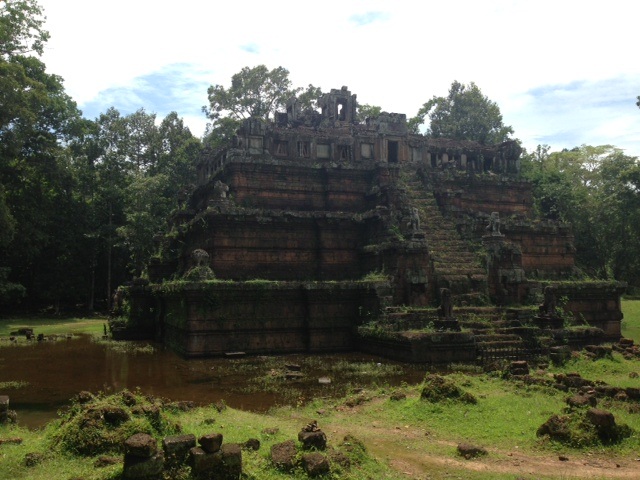
From the top of Baphuon, which, believe me, is a decent climb when it's 95 degrees and 95% humidity outside.
“Cordoned off” is a rough approximation, though.  The entire city is a UNESCO World Heritage Site, and teams from India and Japan are restoring a number of the structures, but it’s also home to any number of villages, some of which have actually been there since Angkor fell.  So Angkor is leading this weirdly layered existence—the cracking stones of the god-kings, relics of a time very much dead and gone; the villagers farming rice, selling cold drinks, and cutting hair in the shade of the banyan trees; and then, somewhere in between the two, the saffron-robed monks texting on their smartphones, the wizened old ladies by shrines set up in front of the remaining Buddha statues selling incense for a thousand riel and promising “long life,” and the children splashing and shrieking in the same moats that served as a defense against Ayutthaya thousands of years ago.  The result is to make Angkor feel simultaneously decaying and living.

To that effect, once you pay your entrance fee, you pretty much have your run of the ruins apart from a few blocked-off areas, and right now, with it being the rainy season, there just aren’t that many people.  It’s entirely possible to find yourself climbing up the side of a moss-covered ruin beneath a half-cleared thicket of trees and vines in complete isolation, save for a cackling bird or two.  On the more minor structures, there are no ropes or rails or stairs, so it’s a matter of hitching your bag over your shoulder, finding a handhold or two, and praying that your feet don’t slip on sandstone that’s endured a thousand years of extreme humidity.  Landmines also pose a legitimate risk once you really get off the beaten track.  For anyone who’s ever harbored a fantasy of stumbling across an overgrown lost city decaying, unbeknownst to the Western world, deep in the jungle, Angkor pushes all the buttons.  One can only imagine what it was like for the first French missionaries to come across it (Angkor, by the way, was never technically “lost”; even after the empire fell, the Khmers were always well aware of its existence and location and continued to worship at the temples) and see these massive structures rising out of the thick of the trees.

The ruins, apart from being expansive, are spectacular.  Rounding the corner of the moat and seeing the gates of Angkor for the first time is so exhilarating that it hardly seems real.  There are no truly great words for that first impact of the dense greens of the forest and the water, the towering palms and banyans, and the storm-grey stone that still exudes this extraordinary sense of power and size, all anchored firmly here long ago and holding court in this heavy air all through Cambodia’s dark ages, French colonialism, Japanese occupation, the civil war, and the Khmer Rouge.  The details on the walls, on every column, every terrace, every tower, still visible after a thousand years and the encroaching jungle and the damage from the war’s artillery, are incredible.  Only a self-proclaimed god-king could order up something like these temples, and indeed, Angkor Wat took about thirty years to complete (thirty years of what appears to be extremely painstaking labor...ugh).

Phinamakeas, one of my favorite temples not just because it's totally feral-looking and again, empty, but because it has an awesome name.
And then there are the little things, small things that pale next to the aged majesty of the city itself, things that I would describe as unexpectedly delightful, even though using the word “delightful” when I’m not being sarcastic makes me feel like somebody’s great aunt.  No one tells you, for instance, that Angkor is completely aflutter with dragonflies and butterflies the size of your palm, circling the towers bedecked the stone faces of long-dead kings and alighting on the moss-covered balustrades like tiny little courtesans.  They’re absolutely everywhere, not buzzing around your ears to be swatted away, not, of course, biting you, just there, a million unpaid street performers.

 No one tells you about the smell, either.  The temples, at least the ones on the main path, are all infused with this lovely fusion of the wet, earthy smell of the forest outside and the light perfume of incense quietly smoking away in front of the remaining Buddha statues.  Lest that bring to mind the cloying heaviness of incense burned inside a church or a stoner’s bedroom, it is the farthest thing from overpowering.  It is the kind of subtlety that I associate with saffron—quite unlike anything else, but delicate enough that it’s hard to put your finger on it exactly.

No one tells you how strongly you can feel that the temples are places of sanctuary, either.  Stepping inside the darkness of the grey stone halls and chambers, the powerful heat outside is quelled to something almost cool, and the noises of the forest, any footsteps, and any comments from other visitors are silenced.  For me, it brought on a rush of childhood memories of escaping the summer heat in Europe by ducking into cathedrals and churches.  Beyond the cool, dark and quiet, the temples are so still inside that you can’t help but settle into an involuntary calmness.  I’m not a spiritual person, but I won’t deny that the very atmosphere inside is something different.

So Angkor may be the stuff of photographers’ dreams, but the pictures will never have the same impact, no matter how beautiful the sunset or sunrise or if a flock of cranes is taking flight from the moat or whatever.  It’s the dragonflies and butterflies and incense-jungle smell and the feeling of momentarily cloistering yourself from the heat in the dark recesses of stone that really bring Angkor to life.

On Monday, I made what would probably rank as one of my best decisions to date and arranged to take a guide and a horse out to the far-flung and little visited ruins of Wat Atvea at about 7am in an attempt to beat the heat (jeans, close-toed shoes, and tropical heat do not mix well).  After much shortening of my stirrups to ensure that my heels actually made contact with the barrel of the tiny little Arab cross I was riding, we set off through the half-dirt half-mud roads of the countryside, ducking beneath jacaranda trees and picking our way around cows lying down for a snooze.  My guide Thon and I were the picture of diligence as we walked through the populated areas, keeping our horses to a docile walk and saying good morning to all of the shopkeepers and farmers and children, but once we hit the open road, it was full speed ahead.  Let’s just say that my horse, Coco, was very different from the tall, solid warmblood types I grew up riding, and had exactly the kind of short, fast stride you’d expect of a little fireball like him.  He was totally game for anything and did a brilliant job of weaving in and out of the angry water buffalo we ran across, hopping over the ditches where the path had crumbled away, and splashing his way through the little rivers created by the wet season.  Flying through the rice paddies on horseback, with the vivid green fields and palms swaying around me in the rising warmth of the early morning, is something I will never forget.  When we arrived at the temples, they were of course completely deserted, with only a few people harvesting rice and stringing up their clotheslines nearby who didn’t give me a second glance.

It’s hardly a surprise that the experience was so incredible.  Temple ruins, horses, and the tropics are three of my absolute favorite things, so combining them effectively blew my mind.

There are a lot of accounts of Angkor, though, and most of them are more interesting than those of some Californian girl with a degree in modern history taking two weeks off her job in banking (I mean, I’ve done my reading, but I’m well aware that the takeaway from the above is pretty much “wow, cool”).  One of the really interesting ones comes from Zhou Daguan, a Chinese diplomat who spent a year in the court of King Indravarman III in 1296, which still serves as one of the primary sources of knowledge for what life was like in Angkor’s heyday.  French explorer Henri Mahout also penned an account that, while wildly inaccurate in many ways and guilty of playing into the European supremacist leanings of the 19th century, is interesting if you take it for what it’s worth.  So go read one of their things.

As for photos, my two underwhelming iPhone photos don’t do it justice…like, really don’t do it justice (the wifi here is also not great, so I’m working with what I have when it comes to uploading).  Again, there are many people out there with real cameras and real photographic knowledge who have done it better.  These are only meant to give a general impression, and I'll update upon returning to a place with more stable internet.

The town of Siem Reap itself is a bit of a world unto itself.  Cambodia as a country is still extremely poor, with GDP hovering just above that of Afghanistan.  In Siem Reap, however, a comparatively huge amount of money flows in from the Angkor tourism, so you have streets full of massive gleaming hotels and chic restaurants with prices on par with those in the West.  All of this is mixed up with structures haphazardly constructed of tarps, corrugated iron, and palm fronds; street vendors crowding each other as they sell unidentifiable things roasted on sticks; and half-paved streets and sidewalks full of potholes.  The Cambodians who live in Siem Reap live in buildings that run the gamut from the above sticks-and-tarps to brand-new neo-colonial villas with soaring ceilings and electric gates, and once you step outside the main urban grid, it’s straight to farm life, and the morning is full of rooster cries and the squeals of pigs.  The majority of people now have electricity, so glance down any given alley and you’ll see a family going about their business, drying spices, doing laundry, chopping vegetables for dinner, with the blare of a TV in the background.  For all the tuk-tuks and rusting bicycles, you’ll also see a surprising number of Range Rovers and Lexus SUVs, which I presume are the rides of choice for well to do Cambodians.  It’s the sort of bittersweet dichotomy characteristic of a world-famous tourist destination that happens to be located in what is still very much a developing country.

A few bits of miscellany:

-The humidity: oh, the humidity!  Yes, sometimes it stings when the sweat runs into my eyes, but this weather is so completely and totally up my alley.  Despite it being the rainy season, I have yet to be rained on and have indeed had mostly clear blue days.  One thing I love about the tropics is that a) the sweating serves as a perpetual detox and b) I can eat pretty much anything I want and it melts away.  Bonus points for hair and fingernails growing crazy fast. 

-Khmer: to put this in finance terms, if given the choice I would definitely short on my becoming fluent in Khmer in the next lifetime.  The alphabet is beautiful, but that’s all I really take away from it—it’s a lovely collection of elegant swoops and twists that happen to share the same line.  There’s also no proper Romanization of the language, so even speaking, when referring to a book, is an adventure, to put it mildly.  And while we’re on languages, I have yet to meet any Cambodians who prefer to use French over English.  After studying the history of Indochine and le Cambodge for years in my school French classes, I confess to being a tiny bit disappointed (also, my French is better than my Khmer).

-Driving: best described as the “ordered chaos” one sees in much of the developing world, perhaps slightly less so due to the fact that Cambodia simply doesn’t have that many cars (indeed, The World’s Most Dangerous Places, which was something of a bible to me at age sixteen, described Cambodia at one point as having so few cars that it “would be lucky” to have road accident statistics).  There are motopeds, tuk-tuks, bicycles, food carts attached to bicycles, pedestrians, and livestock all sharing the same space, and no one is afraid to pass each other, effectively turning the middle of the road into an anarchic no-man’s land.  I trust my tuk-tuk drivers, though, because this is what they do all day.  This isn’t their first rodeo.

-Fruit: heaven!  Between the longans, lychees, mangosteens, rambutans, and soursops, their rainbow of textures and colors all piled next to each other in the markets, I am completely spoilt for choice.  And the coconuts…well.  Well, well.  Let’s just say that if I had my way, every country would follow Cambodia’s example and have baby green coconuts for sale on every corner, just waiting to have their tops hacked off, straws at the ready.  For those who haven’t tried it, you will never want to pay three dollars for coconut water in a can ever again.

06 April 2013

Resurfacing

You can judge me for eating
half-baked brownie goo more often than
medical professionals advise, though. 

It's been an embarrassingly long sabbatical, but I've cleared out the cobwebs and have flexed my writing muscles for something other than summarizing credit overlay matrices (which are a real thing; I didn't just make that up).  Like a duck that has held its breath and dug for grubs in the mud, or whatever it is that ducks to do get their food, I am now resurfacing.  Please do not judge the rest of this post by that truly awful simile.

In the Western world, there’s a very popular narrative that follows “conventionally successful” people.  It involves someone in a “conventionally prestigious career,” like law, medicine, finance, politics who has everything he or she is supposed to want but is lacking that life-affirming sense of satisfaction.  Said successful person takes a leap of faith and pursues that oft-cited road less travelled, changes his or her entire life, simplifies/streamlines/some variation of that verb, and finds that life-affirming sense of satisfaction.  Usually, this narrative involves a wealthy white person “finding him/herself” with the help of non-white people.  Eat, Pray, Love is probably what comes to mind (apparently the author was actually given an advance by her publishing house to finance her nine months of self-finding, if you’re curious).

This narrative doesn’t even have to involve the whole cultural shift.  Think of that guy you heard of who quit his job at Goldman Sachs to become a painter.  Think of the lawyer who was at his desk at 11pm, had an epiphany, quit his job, and moved his family out of the big nasty city and into a place where they might not be rich but where they could connect with nature and breathe fresh air.  God, think of that Nicolas Cage film The Family Man.  Weirdly enough, we’re taught to believe that all the things that are right to pursue are actually wrong and that breaking from convention! is where the true meaning of life lies.

(Just to fuck with you, though, you should still want all the things you should want.  I’m sure there’s a way to reconcile those two things, even though they’re mutually exclusive.  This is why there are so many Tibetan craft shops in places like Marin County.)

A year ago, I had a plan.  My plan was to get my TESOL (Teaching English to Speakers of Other Languages) certificate and to teach English in China.  The end goal was to, after a year, have enough contacts that I could find a job in international trade or finance over there, which is a logical but definitely not a guaranteed outcome.  Everyone waxed poetic about how brave and exotic this plan was to the point that you would have thought I planned on becoming fluent in Lingala, hot air ballooning over the Congo River basin, and setting up a sculptors’ commune in the Ruwenzori Mountains.

I might have actually had somewhere to wear the multitude of traditional clothing I bought during my internship in Tanzania.  Pictured: me at 17, significantly less clued in to pretty much everything.

Needless to say, it was pretty flattering.  I felt terribly cool.

However!  To support myself while I got certified, I was writing and researching for one of my dad’s associates in the mortgage banking industry, which meant that I was working in not just in finance, but probably the most hated sector of finance (in case you somehow missed the ulcer-inducing collapse of the global economy back in 2008).  Saying that you work in mortgage banking is like the anti-free-spirit-breaking-from-convention.  As far as most people are concerned, you’re more interesting/more ethical/generally a better person in every way if you say that you’re a corporate lawyer…and people hate corporate lawyers.

The thing is, though, that I liked the writing.  I liked learning about the industry and watching and analyzing how the big-picture changes came into effect in response to government regulation or international economic movements or releases of consumer data.  I liked using my brain to wrap my head around the myriad moving parts and how they all affected one another.  No one in finance is supposed to find their job interesting—everyone is supposed to burn out, sell their soul to the devil, lose track of their true passion in their relentless pursuit of moneymoneymoney before falling, weeping, to their knees when they realize just how empty their life is, etc.—but here’s a dirty little secret: some people do.  I won’t say “a lot of people” in finance do, but rest assured that there are some.  I would know.  I’ve worked with them.

So last June, there I was, certified, ready to take my St Andrews degree to go teach English for $1500 a month.  I was up to my elbows in interviews, 95% of them with institutions that were clearly less than ethical in their dealings.  One recruiter told me that he wasn’t sure about actually getting me a job, but that I seemed like “a great girl” and had “a great smile” in my picture and that we should definitely meet up for a beer when I moved out there (oh, totally!).  Another offered me a job (which I accepted), wrote back two days later to say that it had actually been offered to someone else, and then repeated the process with two other positions.  Another told me I should fly to China on a tourist visa and that they would take care of getting me a work visa when I got there (nota bene: if there’s one thing you don’t want to fuck around with, it’s Chinese visas). 

The absolute last thing I wanted was to relocate across the Pacific at great expense and effort to find myself in trouble with the Chinese government with no support from my employee, shelling out insane money for a lawyer, and facing deportation.  If you go looking for horror stories of people that blindly accept teaching jobs overseas, you will find thousands in a matter of seconds—people getting deported, people getting unfairly fired, people signing contracts they can’t understand, people getting a quarter of the pay they’d been promised.  I was 22.  My parents had paid for eighteen years of private education (and a lot of other stuff).  I really, really didn’t want to call home broke and in tears and I really, really didn’t want to feel as though I’d spent another year dicking around before I was on a career path, which I saw as pretty key to becoming a real adult.

On top of that, as much as I loved Shanghai, early summer in the San Francisco Bay Area is seriously nice.  Waking up to yawning blue skies and warm sun day in and day out was glorious after having existed under British cloud cover for so long.  The taste of the drinking water, the ease of getting to the beach or Napa or Tahoe, the fresh produce, the unexpected enjoyment of having my family close by—these were all great.  The Bay Area might have been where I grew up, but deciding to stay here instead of going to Shanghai didn’t feel like a consolation prize (at all).  Not to mention the fact that, in terms of job hunting and laying down a career path, this is where the bulk of my contacts were.

I’m a bond trader now.  I spend a lot of time in Excel, have a calculator that I actually use on a daily basis, and discuss things like deliverables and ROI and risk management.  A typical day involves trading $35 million at a time to investors like JPMorgan Chase and Wells Fargo, tracking the Cyprus bailout plan, and discussing strategy with our hedging guys on the east coast.  There are expensed dinners with investors where lighthearted chat gives way to hardball negotiation and bluffing after a few bottles of wine are put away.  The office is a total boys’ club, and I get a lot of flak if I order a vodka cranberry instead of a neat scotch when we go out for happy hour (“imagine if you’d ordered some pink girly shit like that when you were out with a bunch of other traders on Wall Street; they’d never take you seriously again”).

Outside of work hours, I live in a new apartment with pool, jacuzzi, gym, deli, and dry cleaner on site right next to the bay, and it feels like my own personal oasis.  If it’s 3am and I’m six miles from home in a bad neighborhood, I can take a taxi and not stress over how much more it’s costing than the bus.  When I’ve had an exhausting day, I can opt for takeout instead of trekking to the grocery store and cooking.  My friends and family will confirm that the quality of their birthday and Christmas presents has taken a turn for the better.  I can pick up the tab when one of my friends has a special occasion, donate as an alum to my schools, and leave the kinds of tips that I like to think are actually a pleasure to receive, as opposed to the you-can-tell-how-much-I-resent-this-particular-social-custom kind of tips.

Oh, and I should actually be able to get into the housing market down the line so I’m not hemorrhaging money for rent every month for the rest of my life.  O-M-effing-G.

So, if I were to be considered successful, it would be successful in a very conventional way—and I don’t even hate what I do!  Another dirty secret—in fact, I really like what I do, and I like the people I do it with!  No one’s going to make a Hollywood epic about it, but I’m pretty okay with the Eat, Pray, Love devotees and other free spirits not thinking that I’m doing something “cool.”

Years ago, I remember my dad saying that after decades in the industry, he still woke up every day excited to close another deal.  If I could at some point have that in a job, I thought to myself, that would be awesome.  I believed that, if I had a job that made me feel that way by the time I was fifty, I would have arrived.  I have that right now at age 23 (well, almost 24…urgh).  I genuinely look forward to going to work in the morning, which I’m fairly certain that that translates to satisfaction.  I’m not walking around in a perpetual state of existential ennui wondering how life got to be filled with so many things but to be so devoid of real meaning.  I’m actually pretty fucking happy. 

As for the idea that I turned down a life-changing opportunity or took the “boring” or “sell-out” path, I can see how my choices might have come across that way.  Consider this, though: there’s a reason that rent in San Francisco is astronomical.  People want to live here, and that’s because it’s a fantastic and bizarre city and it's San Francisco to the core—in no way does it feel like a so-called “typical” developed world city.  For all the experiences I may be “missing out on” by not living in China, there are an equal number I am getting by living here (like taking BART through downtown Oakland at 10pm on a Thursday—when you’re sober it’s terrifying, but when you’re buzzed it’s hilarious!).  I’m also sure that there are Shanghainese 23-year-olds who are working in finance who considered taking that alternative path and moving the San Francisco but who are tremendously happy with what they did opt to do.  Kind of like Chinese mirror Cecis.

Maybe my sixteen-year-old self, if I could get in touch with her, would be rolling her eyes at how very boring I turned out to be.  Keep in mind, though, that my sixteen-year-old self was in many ways kind of an idiot…and didn’t appreciate the value of a really excellent 1997 Napa Valley cabarnet.

This is where I get to live my life as a, uh, soulless drone.  

20 August 2012

Insider trading and love in the tropics


This may surprise a lot of people, but I was unclear on the exact definition of insider trading until very recently. I had a general idea, of course, thanks to that Martha Stewart case a few years ago, but if you had asked me to provide a definition, I would have had produced little more than vague, buzzword-laden sentence fragments and sweeping hand gestures.

Then, the other night, I was out to dinner with my dad and brother Ted as a sort of last family hurrah before said brother moved to New York (if you’re reading this, I’m very happy that you landed such an excellent job with great perks and advancement opportunities etc etc etc, but I’m still mad at you for abandoning me). My dad was scheduled to make a trip to Orange County in the next couple of days, and being a naturally curious person, I asked him what it would entail.

‘We’re working with a lender down there and a private equity firm that’s going to give them $X million of capital,’ he told me.
Private equity! That was interesting.
‘Which lender?’ I asked. My father shook his head.
‘I can’t tell you that.’
‘Oh, come on,’ I protested. ‘Why not? It’s not like I’ll shout it from the rooftops or tell Rob.’ (My boss, whose commentary is read by tens of thousands of people on a daily basis.)
‘No, I can’t tell you,’ my dad repeated.
I was a touch put out. Was there a general perception that I couldn’t be trusted with secrets? That I wasn’t worthy of being privy to the company’s goings-on? I was about to get really offended when Ted spoke up.
‘If he told you, that would be, like, a textbook instance of insider trading,’ my brother helpfully pointed out.

Oh.

Moral of the story, if someone you know is about to coordinate a deal with a public company that involves a lot of capital, don’t be offended that they won’t give you the details. They’re probably just trying to not get put in prison for white-collar crime.

On a totally unrelated note (or is it?), I type this from the beautiful island of Maui, one of the most stunning of Hawaii’s numerous stunning islands. The ocean’s waves are crashing softly on a spit of golden sand and making that peaceful rustling noise I love so much, and a line of slender palms are waving their fronds in the light breeze. The air feels the exact temperature of my skin so that I blend into the summer evening like an unwitting ninja.

I am back in the tropics, and I am very, very happy.

Hawaii was utterly last minute. My friend Clare texted me last Friday with a message that read: ‘Hawaii 15-22. are you free?’ I’m not sure what I texted back, but I think it was along the lines of ‘fuck yes,’ give or take ten exclamation points. A ticket was booked, I cancelled an appointment or two, my shorts were washed, and that was it.

Clare and I can be found wreaking havoc in San Francisco most weekends, reveling in the fact that we can legally drink alcohol in this country, but we go way back, all the way to the halcyon days of the mid-2000s. We both attended The Branson School, where we sat our myriad AP tests and had class in the glen in nice weather and occasionally skipped class to go to the beach and got told constantly how vital it was that we go to a Prestigious University™.

In no particular order, things I adore about being in the tropics:

1. It’s hot. Duh. Not having to wear a jacket at night is one of life’s great pleasures, as is being able to walk around in a bikini shoeless. In temperate climates, I sort of feeling like everyone else is operating at their peak and I, with my blue lips and chattering teeth, am at something of a disadvantage. When I come to the tropics, I’m enlivened by the heat, not unlike a warm-blooded reptile, and frolic around with boundless energy as everyone else drags. The view is nice from the other side.

2. It’s humid. This means hair and fingernails that grow faster (!), better digestion, improved circulation, soft skin, and a glorious feeling of exhaustion at the end of the day. Long ago I discovered that I physically function much better in humid weather, so my body feels fucking amazing right now, to put it indelicately.

3. Delicious fruit. Papayas, pineapples, guavas, those tiny sweet bananas, and my personal favourite, coconuts, are all present here in abundance. They also taste much, much better when they’re not carted across an ocean.

4. The dim mauve coolness of the early morning before the sun rises. For some reason I can’t fully explain, I really love that before-the-waking-people time of relative freshness. I imagine it to be the time when those who need to get things done bustle about and do them so that they’re out of the way before the lazy heat rolls out and the folk on holiday whose to-do lists consist of ‘read crappy book’ awaken. 

5. Bright colours. The flowers, the birds, the ocean, the houses. You’re allowed to paint your house persimmon in the tropics. You’re allowed to wear lime green without people scowling like you’re hurting their eyes. I don’t even wear bright colours most of the time, having retreated into a preference for exiting shade like dark blue, hunter green, and grey, but I find this immensely cheering.

6. The architecture. Tile floors, high ceilings, old creaky wooden fixings, dilapidated shingles worn down by heavy, damp air—all unassumingly glorious. I love that sense of ‘it’s not perfect, but it does its job, so whatever.’ Cold weather requires a sturdy house, a powerful heating system, plush carpeting, and lots of thick-legged furniture, in my opinion, otherwise you risk a Siberian gulag-type vibe. Having had a lot of experience of what it’s like to be mind-numbingly and painfully cold, I panic at the thought of being in a rickety house where air whistles through the cracks in the foundation.

7. The excuse to drink particular cocktails. Ordering a daiquiri, mai tai, or, heaven forbid, a pina colada in the middle of Tokyo or London or New York is kind of gauche. Even in California, it’s kind of gauche. Being in the tropics, this is not only acceptable but encouraged (I pointedly ignored my mother’s observation that ‘pina coladas are pretty fattening, you know,’ which she told me over the phone this morning).

8. Geckos. They’re cute. They make funny noises.

9. It’s green. There is something very satisfying about existing amidst miles of greenery after having existed in an arid landscape for a long time.

10. Being allowed to run late. In Indonesia, one often hears the term jam karet, which translates literally to ‘rubber time.’ In Hawaii, it’s ‘island time.’ The technical and much less charming term is polychronocity, a polychromic culture being one where a deadlines or appointment are really just suggestions. Singapore is one of the very few tropical places that comes to mind where a monochronic culture exists, but in places like Tanzania, Guatemala, Sri Lanka, or the majority of the Caribbean, you can pretty much run twenty minutes late and no one cares. As someone who is perpetually running twenty minutes late, I appreciate this very much.

12 April 2012

Why I don't write much anymore

The reason I don’t write much anymore is because I spend most of my time writing. What! What japes are these? you may exclaim. Since January I’ve been working in the wide world of mortgage banking consulting, which most people react to with an about-face and a bland ‘mmm.’ On the How Cool Your Job Sounds scale, mortgage banking consulting is one step above ‘I’m in insurance’ but still at the opposite end of the spectrum from Supermegafamous Rockstar Deity, modern day treasure hunter, and happenin’ club owner. I’m usually quick to add that it’s actually really interesting (really interesting!) but no one ever believes me. I’ll bide my time. You’ll see, when you’re trying to get an FHA loan but have disputed and/or outstanding collection accounts exceeding $1,000 and are desperate to know if there have been any recent underwriting policy changes, I’ll have the last laugh.

You can see the fruits of my labours at http://robchrisman.com/, though my name doesn’t go on any of it because for some reason mortgage folk tend to trust people with MBAs and several decades of experience in the biz over some punk 22-year-old who has never owned a property. If you want to go all out you can even subscribe to the daily commentary and talk shop with that plethora of mortgage bankers you know. There’s always a joke at the end, and no, I have nothing to do with that part (she said humourlessly). And I do mean to be more on top of putting stuff in the blog. Really, I do.

Plus I get to do this in California, which isn’t bad at all. Tee hee.

This isn’t meant in any way to be ‘promotional,’ and I’ve decided to finish it off with a picture from the simultaneously terrifying and hilarious 90s cartoon Bananas in Pyjamas.


Somewhere along the line, there was a person who said, 'Let's make a children's show about anthropomorphised fruit that wears an article of clothing that rhymes with its name. Oh yeah, let's make them doctors too.'

08 December 2011

Reason #673 I'm going to hell

As a heathen/infidel/general non-believer, I don't actually believe in hell. Somewhat ironically, it is exactly this lack of belief that makes many religious folk certain that I will end up there. So this isn't about the afterlife, unless you consider fending off the advances of charity muggers ('chuggers') for eternity to be some kind of purgatory.

On any given day, my local high street is lined with four to six people holding clipboards and standing in the middle of the pavement. They plant themselves in front of the post office and the giant Sainsburys (east pavement) and HSBC and Caffe Nero (west pavement) so that it's impossible to avoid them if you want to get to the tube station or do your food shopping. Sometimes they wear matching jackets (now I've made them sound like they're part of a cult-they're not). Should you make eye contact, they will lock their gaze on yours and grin manically as you walk towards them, and then, when you're within five feet, they pounce.

These are the chuggers, and I hate them. They work on behalf of large charities (Save the Children, Help the Homeless, Shelter, Cancer Research, etc) that can afford to employ people to stand out in the cold and assault strangers for eight hours. Their goal, with their handy clipboards, is to pitch the organisation to passersby and then securing people's direct debit details to sign them up for a monthly donation. It's officially called Face to Face fundraising, or 'F2F', by the charitable sector. The charitable sector prefers not to use the term 'chugger', for obvious reasons.


One of these. White dreadlocks not obligatory, but clearly encouraged.

'Hold on, you're saying that you hate charity,' you might be thinking. 'You're a jackass.'

But I don't hate charity. My mother has worked in non-profit development for the best part of the past three decades. I donate annually to a number of different causes. I spent a summer planting ebony saplings in an effort to reforest Mt Kilimanjaro. Soup kitchens, Adopt A Family, alumni donations, teaching English, giving away winter coats, you name it. You don't grow up in the San Francisco Bay Area, the heartland of liberalism, and hate charity.

My beef lies with the chugging method. If I mistakenly make eye contact with one of them as I'm walking down the street, a wave of genuine dread rolls over me. For the next hundred feet, I swivel my head wildly in an attempt to find an escape route (there never is-both sides of the street, remember?) or in the futile hope that I can pretend as though I don't see them, and maybe, just maybe, they'll let me by. But the chuggers never do, and as soon as I draw level with them they lunge-yes, lunge!- and shout, 'HELLO MISS HOW IS YOUR DAY COULD I TAKE A MINUTE OF YOUR TIME TO TELL YOU ABOUT [Large Charity X]!'

There are a few reasons why I find this so irritating.

1. I don't enjoy being shouted at. Unless there's a man behind me with an axe that's aiming for my neck and you're shouting, 'Duck!', I just don't see why it's necessary.
2. When I'm walking down the high street, I'm usually walking somewhere to do something I would like to get done in a timely fashion (if it's raining, windy or below 10 degrees outside, this goes double). Rarely do I, or anyone else for that matter, take a leisurely stroll down a busy city street.
3. In London, if a random jumps out at me, I naturally assume that he's got a knife and is aiming to either mug or stab. That momentary fear for my life, no matter how quickly it dissipates, does not leave me feeling particularly warm and fuzzy.
4. I already donate to charities of my choosing, and I'm not exactly thrilled at the idea of leaving my direct debit details with someone whom I've literally met on the street.
5. How is my day? Really? I would love to see someone stop in their tracks and give a chugger a blow-by-blow of this morning's carpool, how both the coffee machine AND the copier broke in the office, the lunchtime dry cleaning pickup, that super funny video of the camel being tickled!, and the conference called scheduled for 4 o' clock and watch the chugger act interested. Look, chuggers, you don't care, and I know you don't care, so, to put it indelicately, cut the crap.

Usually, I just fend them off by saying, 'Sorry, I'm running late', which is easy enough, but when you've gotten past one just to deal with another five on the same stretch of pavement, it tests your patience. Sometimes, frankly, I'm exhausted already and don't have the energy to deal with them at all.

There was one such day a few months ago when I was coming back from a long, difficult job assessment that had left me tired, downhearted, and rather certain that I wasn't going to get the job. My business heels had ceased to be comfortable several hours ago, and I was so excited about swapping my blazer and pencil skirt for my old Berkeley jumper that I debated calling a taxi for the 90-second ride home from the bus stop. Having pelted out the door that morning at such a high speed that all I had time to grab was a single carrot, I was also starving, and it was the thought of a fresh insalate caprese drizzled with olive oil that kept me going. Unfortunately, as I walked from the tube towards the giant Sainsburys, I realised that I was was heading straight towards a girl with a neon scarf, a clipboard, and a red Shelter jacket. Yes, one of them.

She was both louder than average and incredibly agile, darting from one side of the pavement to the other and letting no pedestrian pass without a shouted appeal. It was clear there was no way I could get to my tomatoes, basil and mozzarella in peace, as she clearly had this side of the street covered, and her Shelter cronies had the other side heavily manned. Caprese. Caprese. Caprese, I repeated internally, willing myself to go forward. I hugged exterior of the HSBC branch, but sure enough, there she was in a flash, hollering, 'HELLO MISS HOW ARE YOU TODAY CAN I-' I was so drained that I didn't even have the energy to make up some excuse, and simply walked on past.

There was a three-second pause, and then this girl yelled, at my retreating back, 'YOU DON'T HAVE TO BLANK ME, YOU KNOW!'

Had this been a film, I would have stopped dead in my tracks, slowly turned around, and said, 'WHAT did you just say to me?' I mean, really, if you're trying to get someone to give money to you is berating them the way to go? Did this neon-scarf wearing twit really think that was at all helpful?

Needless to say, she just fanned the flames.

Fast forward a few months to a bitterly cold, grey, damp excuse for a day. After lying low all afternoon with a very unattractive cough, I decided to make the trek to Sainsburys and buy some almonds for no other reason than I really wanted almonds. I bundled myself into a faded jumper, my sheepskin coat, scarf and a pair of black fleece-lined jodhpurs that are so thick they make my legs look considerably fatter. The look was not a particularly good one, but I had stuck my hand out the window to gauge the temperature, and I didn't care if I looked like the Yeti's ugly cousin so long as I would be able to brave the chill.


How I see my walk to the store


(Note: I make it sound as though it were five below zero and I live three miles from the nearest supermarket. In reality, it was probably about ten degrees and there's an enormous Sainsburys less than ten minutes from my front door. But I was having a rough time.)


My actual walk to the store. It's short. Like really short.

I was within a couple hundred feet of my precious almonds when I spied a tall guy in a black jacket holding a clipboard. Oh, please, just this once, let him not make eye contact with me, I thought. I was far too cold to deal with this. I didn't want to be outside a second longer than necessary. I scrabbled in my pockets for my phone or my iPod. No luck-I hadn't thought I'd need either. I craned my head at an improbably and uncomfortable angle in a desperate attempt to avoid his gaze, but it wasn't enough. The next thing I knew, there he was in front of me, enormous mad smile and all. He launched right into it: 'HELLO MISS HOW ARE YOU TODAY CAN-'

And, as I shivered beneath my ugly jumper and fat-leg jodhpurs, something inside me just snapped. I narrowed my eyes and told him, 'Not great. I just got diagnosed with TYPHUS.'

The second I said it, I was mortified. Typhus? What was I thinking?! Typhus, that disease often found in prisons and refugee camps and known as 'jail rot'. That disease extremely rare in London, especially in girls wearing Armani watches. That disease whose symptoms include rashes, stupor and delirium-not walking to Sainsburys to satisfy a craving for almonds. It was painfully, glaringly, spectacularly obvious that I did not have typhus.

Neither the chugger or I knew what to do. Still horrified, I ducked my head and quickly walked into the store as he stammered, 'Oh...erm...sorry.' I tried to keep it together as I selected the perfect almond option in the nuts aisle and shelled out a couple of pound coins. Okay, it was a shitty thing to do, but what's done is done, and it didn't actually harm anyone, I reasoned. But then I realised that, unless all of the chuggers had spontaneously decided to go home in the last five minutes, the guy would still be out there. Hopefully, in light of the awkward situation, he would just ignore me, because, really, who would actively try and exacerbate such awkwardness, am I right?!

My almonds and I had almost made it past and I was thinking of which film to stream when he struck. 'HELLO MISS HOW ARE YOU TODAY CAN-' Oh, holy shit. I sighed uncomfortably.

'Erm. I'm the girl with typhus, remember?' I mumbled. He took a step back.

'Oh. Right. Sorry,' he mumbled in return. We both fled.

Chuggers continue to irritate me for all those reasons listed above. However, I've since realised that there are better ways of fending them off than faking typhus, and, although it certainly worked, I still get the occasional twinge of guilt. Because I'm pretty sure, in religious circles, that sort of thing does indeed earn you a one-way ticket to hell.